Indexed Universal Life Insurance (IUL)
Permanent protection with living benefits and cash value growth potential.
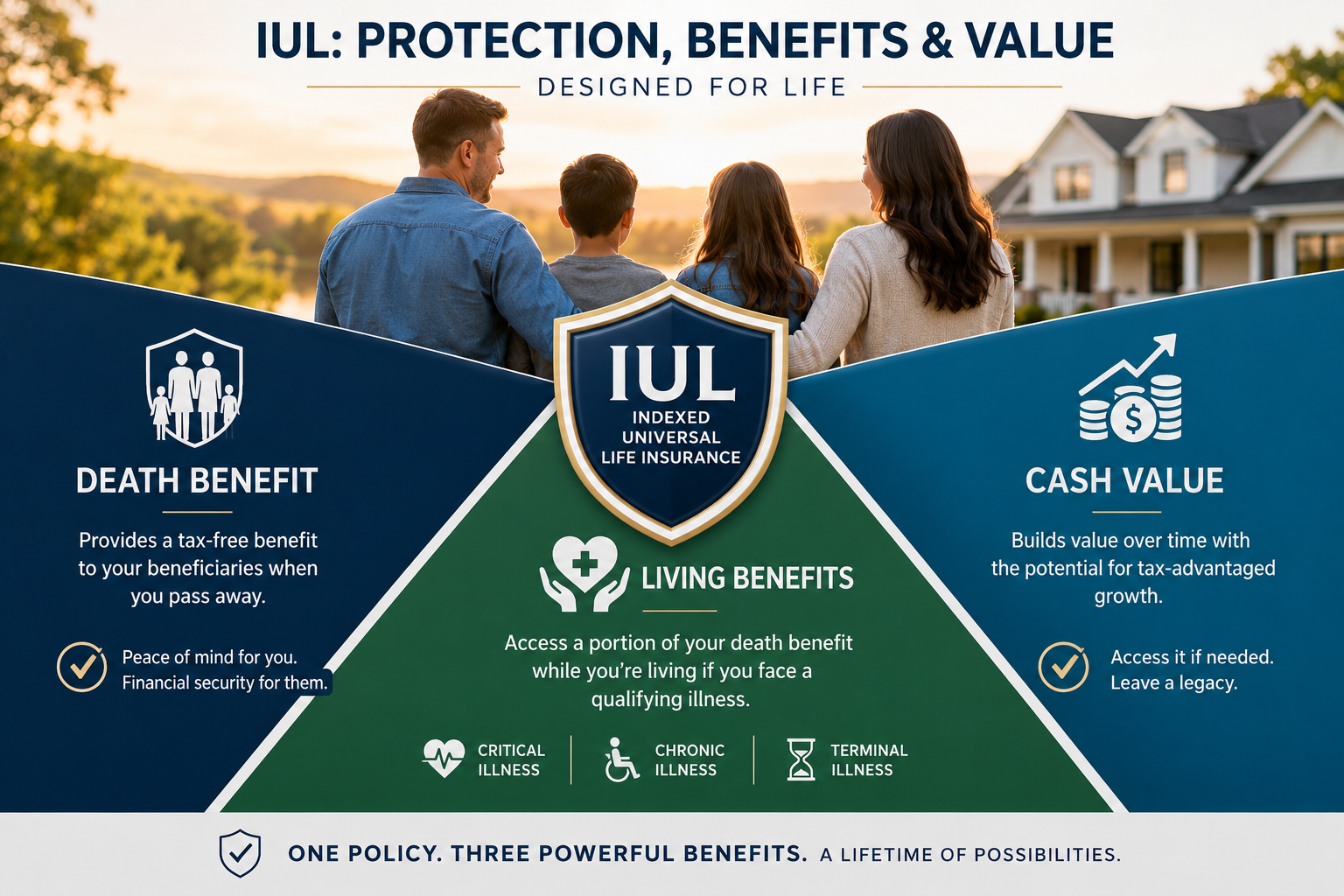
Indexed Universal Life (IUL) is a type of permanent life insurance designed to provide a death benefit while also offering the potential to build cash value over time.
Depending on the policy, it may also include living benefit riders that can provide access to a portion of the death benefit following certain qualifying illnesses.
Why Consider an IUL?
Permanent Protection
IUL is designed to provide life insurance protection rather than coverage for only a specific term, provided the policy remains in force.
Living Benefits
Certain policies may allow access to a portion of the death benefit while you're alive following qualifying terminal, chronic, or critical illnesses.
Cash Value Potential
Cash value may earn interest based in part on the performance of a selected market index, subject to the policy's crediting terms.
How Does Indexed Universal Life Work?
1. You Pay Premiums
Premium payments fund the policy, subject to policy requirements and applicable limits.
2. Policy Charges Are Deducted
IUL policies have insurance costs and other policy charges.
3. Cash Value Can Accumulate
Remaining policy value may earn interest through available fixed or indexed crediting strategies.
4. You Have Life Insurance Protection
As long as the policy remains in force, it can provide a death benefit to your beneficiaries.
Life Insurance You May Be Able to Use While You're Living
Life insurance is traditionally associated with a benefit paid after death.
But certain IUL policies may include accelerated death benefit riders, commonly referred to as living benefits.
Depending on the policy, these may provide access to a portion of the death benefit following a qualifying:
Critical Illness
Certain qualifying serious illnesses or medical events may allow access to benefits according to the policy's definitions.
Chronic Illness
Benefits may be available when the insured meets the policy's requirements for a qualifying chronic illness.
Terminal Illness
A qualifying terminal illness diagnosis may allow the insured to accelerate a portion of the death benefit.
Why Can Living Benefits Matter?
A serious illness may affect more than your health.
It can affect your:
Income • Mortgage • Monthly Bills • Savings • Family
Living benefits may provide additional financial flexibility during a qualifying event.
Living benefits are generally provided through accelerated death benefit riders. Availability, qualifying conditions, costs, limitations, and benefit amounts vary by policy and carrier. Accelerating benefits generally reduces the remaining death benefit and may affect other policy values.
HOW INDEXED INTEREST WORKS
How Can an IUL Earn Interest?
An IUL may offer one or more indexed crediting strategies.
The interest credited to an indexed strategy is determined in part by the performance of an external market index, such as the S&P 500®, according to the policy's crediting formula.
Important:
Your money is NOT directly invested in the S&P 500 or stocks.
The index is used as a measuring tool to determine potential interest crediting.
WHAT AN IUL IS — AND WHAT IT ISN'T
Understanding What You're Buying
An IUL is:
✓ Permanent life insurance
✓ A death benefit
✓ A policy with cash-value potential
✓ Able to offer indexed interest-crediting options
✓ Potentially available with living benefit riders
An IUL is NOT:
✕ Direct ownership of the S&P 500
✕ A stock-market investment account
✕ Guaranteed to receive positive indexed interest every year
✕ Free from insurance costs or policy charges
The performance and longevity of an IUL depend on how the policy is designed, funded, credited, charged, and managed over time.
WHAT CAN YOU USE CASH VALUE FOR?
Accessing Your Policy's Cash Value
If sufficient cash value is available, policy owners may be able to access it through withdrawals and policy loans, subject to the contract.
People may consider available policy value for different financial needs.
Policy loans and withdrawals may provide access to available policy values, but they can reduce cash value and death benefits, may increase the risk of lapse, and can have tax consequences.
TALK WITH A LICENSED PROFESSIONAL
TERM vs WHOLE LIFE vs IUL
Which One Is Better?
There isn't one type of life insurance that's best for everyone.
Your appropriate coverage depends on your:
Family • Income • Budget • Age • Health • Goals • Protection Needs
WHO MAY CONSIDER AN IUL?
Is an IUL Right for You?
Parents
People looking for long-term protection for their families.
People Interested in Living Benefits
Those who want to explore policies that may provide benefits following certain qualifying illnesses.
People Seeking Cash Value
Those interested in permanent life insurance with cash-value accumulation potential.
Long-Term Planners
People who understand that IUL is generally a long-term insurance product that requires ongoing monitoring.
Families With Long-Term Financial Responsibilities
Those who want permanent coverage as part of a broader financial protection strategy.
-
Description text goes here
-
Description text goes here
-
Description text goes here
Protection for Today. Possibilities for Tomorrow.
An IUL can be more than a death benefit, but understanding how the policy works is essential.
Let a licensed insurance professional help you compare your options and determine whether Indexed Universal Life Insurance fits your needs.
Indexed Universal Life Insurance is a life insurance product, not a direct investment in any stock or market index. Index performance does not include dividends unless specifically provided by the applicable crediting methodology. Caps, participation rates, spreads, floors, charges, riders, and other policy features vary by product and carrier and may change where permitted by the contract. Policy loans and withdrawals reduce available cash value and death benefits and may cause the policy to lapse or create tax consequences. Living benefits are subject to eligibility requirements, limitations, and policy terms.