Children’s Life Insurance
Start Their Protection Early. Give It Time to Grow.
Most parents insure the things their children depend on the home, the car, even their health. But life insurance for a child can serve a different purpose: Start protection while they're young, help protect future insurability, and with certain permanent policies, begin building cash value early.

Why Consider Life Insurance for a Child?
They're Young Today. A Lot Can Change Before Adulthood.
Thankfully, most children grow up healthy. But health and insurability can change unexpectedly.
Consider:
❤️ About 40,000 babies are born with a congenital heart defect each year in the U.S.
🏥 About 1 in 33 babies is born with a birth defect in the United States.
🚗 Accidents are a leading cause of death among children, with motor-vehicle injuries among the major causes of injury deaths at certain childhood ages.
👦 5,940 children ages 5–14 died from all causes in the U.S. in 2024.
The goal isn't to expect the worst.
It's to recognize that we don't know what a child's health or ability to qualify for life insurance will look like years from now.
It's About More Than a Death Benefit
It may help protect their future insurability.*
It allows you to start coverage while they're young.
It provides a death benefit that can help with funeral and other family expenses.
It may build cash value.*
Certain policies may include Living Benefits.*
Disclaimer:
Cash value and Living Benefits are available only on certain individual permanent life insurance policies and are subject to policy terms, eligibility, and carrier availability. Children’s Term Riders do not build cash value and generally do not include Living Benefits. Future insurability, guaranteed purchase options, and conversion privileges vary by policy, rider, and insurance company.
Three Ways to Insure Your Child
There isn't one type of children's life insurance that's right for every family.
The three options we'll focus on are:
1. Children’s Term Rider
Affordable Protection During Childhood
A Children’s Term Rider is added to Mom or Dad’s life insurance policy rather than purchasing a separate policy for each child.
Mom or Dad has life insurance
Adds a Children’s Term Rider
Eligible children are covered under the same rider
Depending on the insurance company:
1, 2, or even 6 eligible children may be covered for the same rider cost.
Future newborn children may also become eligible for coverage.
Some carriers offer up to $50,000 of coverage per eligible child.
Coverage commonly continues until around age 25, but may end earlier based on the carrier's eligibility rules.
Some riders may allow the child to convert the coverage to an individual permanent life insurance policy later without new medical underwriting.
What Does a Children’s Rider NOT Provide
❌ No Cash Value
A Children's Term Rider is term insurance. It generally does not accumulate cash value.
❌ No Living Benefits
The child rider generally does not provide the critical, chronic, or terminal illness living benefits that may be available with certain individual life insurance policies.
❌ Not Permanent Coverage
The rider eventually ends. If you want coverage to continue into adulthood, an available conversion option may need to be exercised or separate coverage obtained.
Some carriers provide a conversion option that may allow an eligible child to convert coverage into their own permanent life insurance policy without new evidence of insurability. Conversion ages, amounts, deadlines, and available policies vary by carrier.
How It Works
For example, Mom or Dad purchases life insurance and adds a Children's Term Rider.
Whether you have:
1 child → same rider cost
2 children → same rider cost
6 children → same rider cost
Eligible children can generally receive the rider's coverage amount individually, subject to the carrier's terms.
Some carriers may offer up to $50,000 of coverage per eligible child.
What If You Have Another Baby?
Depending on the rider, future eligible children may also be added or automatically become covered after meeting the rider's eligibility requirements. So you may not need to purchase a completely new rider every time your family grows.
How Long Does Coverage Last?
Children's Term Riders are temporary.
Coverage commonly ends around age 25, but it may end earlier under certain rider provisions or life events.
Depending on the carrier, these may include things such as:
Getting married
No longer being an eligible dependent
Leaving the household
Reaching the rider's maximum age
The parent's underlying policy or rider terminating
This is why the actual rider contract matters.
2. Children’s Whole Life Insurance
Permanent Protection That Grows With Your Child
Unlike a Children’s Term Rider, Whole Life is an individual life insurance policy for the child.
The policy can provide permanent protection that can continue into adulthood as long as required premiums are paid.
Parent purchases an individual policy for the child
Permanent life insurance protection begins
Builds guaranteed cash value over time
Policy can continue into adulthood
Depending on the insurance company:
Coverage may be issued from 14 days old through age 17.
Some carriers may offer anywhere from $5,000up to $50,000 in coverage.
Premiums are typically fixed/level according to the policy.
The policy builds guaranteed cash value based on a schedule in the contract.
The child can keep the policy into adulthood as long as policy requirements are met.
Certain policies may provide opportunities to purchase additional coverage in the future, subject to the policy or rider provisions.
Cash Value
💰 Whole Life builds cash value.
Unlike a Children's Term Rider, part of the value of permanent Whole Life insurance is that the policy can accumulate guaranteed cash value according to the policy's schedule.
The longer the policy remains in force, the more time that value has to accumulate.
Living Benefits
❌ The Children's Whole Life products we're describing here do not include Living Benefits.
This is an important difference when comparing Whole Life with certain other individual policies that may offer qualifying living-benefit riders.
Issue ages, coverage amounts, premiums, cash values, guarantees, future purchase options, and availability vary by insurance company, product, and state. The specific Children's Whole Life products described here do not include living benefits. Guarantees are subject to the policy terms and required premium payments.
3. IUL for Children
Permanent Protection With More Cash-Value Growth Potential
With an Indexed Universal Life (IUL) policy, a parent can purchase an individual permanent life insurance policy for their child.
The parent generally owns and controls the policy while the child is a minor.
Parent purchases an individual policy for the child
Permanent life insurance protection begins
Cash value has the potential to accumulate
Policy can continue with the child into adulthood
Depending on the insurance company:
Coverage may be issued starting as early as 14 days old.
Minimum coverage may start around $50,000 with some carriers.
Coverage may potentially exceed $1 million when justified and permitted under the carrier's juvenile underwriting guidelines.
Premiums are flexible, subject to policy requirements.
Parents may choose to fund the policy with more than the minimum required premium to emphasize long-term cash-value accumulation, subject to policy and tax limits.
Many carriers offer Living Benefits with eligible IUL policies.
Available cash value may be accessed through policy loans and withdrawals.
Who Owns the Policy?
The Parent Starts It. The Child Can Eventually Take It Over.
While the child is a minor, the parent or other eligible adult generally owns and controls the policy.
Once the child reaches adulthood, ownership may be transferred to the child, subject to the insurance company's procedures and applicable law.
That means a policy started during childhood could eventually become a financial asset the adult child owns and manages.
Flexible Premiums
You Can Fund It Based on the Goal
One major difference between IUL and traditional Whole Life is premium flexibility.
Subject to policy requirements and limits, parents may be able to:
Increase premiums → Put more money toward the policy's long-term accumulation strategy.
Decrease premiums → Reduce contributions when appropriate.
Adjust funding over time → As the family's financial situation changes.
Potentially pause out-of-pocket premiums → If sufficient policy value exists to cover ongoing policy charges.
Why would a parent intentionally pay more?
Because with an IUL, the goal doesn't necessarily have to be paying the minimum amount required for insurance protection.
A properly designed policy may be funded with higher premiums to place greater emphasis on cash-value accumulation, while staying within policy and applicable tax limits.
More premium does not automatically guarantee more growth, however. Policy charges, credited interest, death-benefit structure, funding limits, and policy performance all matter.
How Can the Cash Value Grow?
An IUL is not directly invested in the stock market.
Instead, interest may be credited based partly on the performance of an index, such as the S&P 500®, subject to the policy's:
Caps • Participation Rates • Spreads • Floors • Crediting Methods
This provides the potential for cash-value accumulation without directly investing the policy's cash value in the index.
Starting young gives the policy something important: TIME.
Accessing Cash Value
As cash value accumulates, available value may be accessible through:
💰 Policy Loans
💵 Withdrawals
The money could potentially become a financial resource later in the child's life.
Loans and withdrawals reduce policy values and death benefits and can have tax consequences or increase lapse risk.
Potential Supplemental Income Later in Life
If the policy is properly funded, maintained, and performs sufficiently, accumulated cash value may potentially be accessed later through policy loans and/or withdrawals as part of a supplemental income strategy.
Imagine the timeline:
Childhood → Policy begins
↓
Young Adult → Ownership may be transferred
↓
Career & Family → Policy continues
↓
Later Life → Cash value may provide another financial resource
This is not guaranteed lifetime income. Available distributions depend on actual policy values, funding, charges, credited interest, loan provisions, and continued policy performance.
Living Benefits
Protection They May Be Able to Use While Living
Many carriers offer individual IUL policies with Living Benefit riders.
Depending on the policy, these may allow the insured to accelerate a portion of the death benefit following a qualifying:
Critical Illness
Chronic Illness
Terminal Illness
Some additional riders may be available with some carriers. Some rider require extra premium, consult with a Licensed agent to know your options.
Critical Injury,
Alzheimer's
Long-Term Care Rider
Availability and qualifying conditions vary.
CLICK HERE TO LEARN MORE ABOUT LIVING BENEFITS
Want to Understand How IUL Works?
IUL has more moving parts than Whole Life or a Children's Term Rider.
Before choosing one for a child, parents should understand index crediting, cash value, flexible premiums, policy charges, loans, and long-term funding.
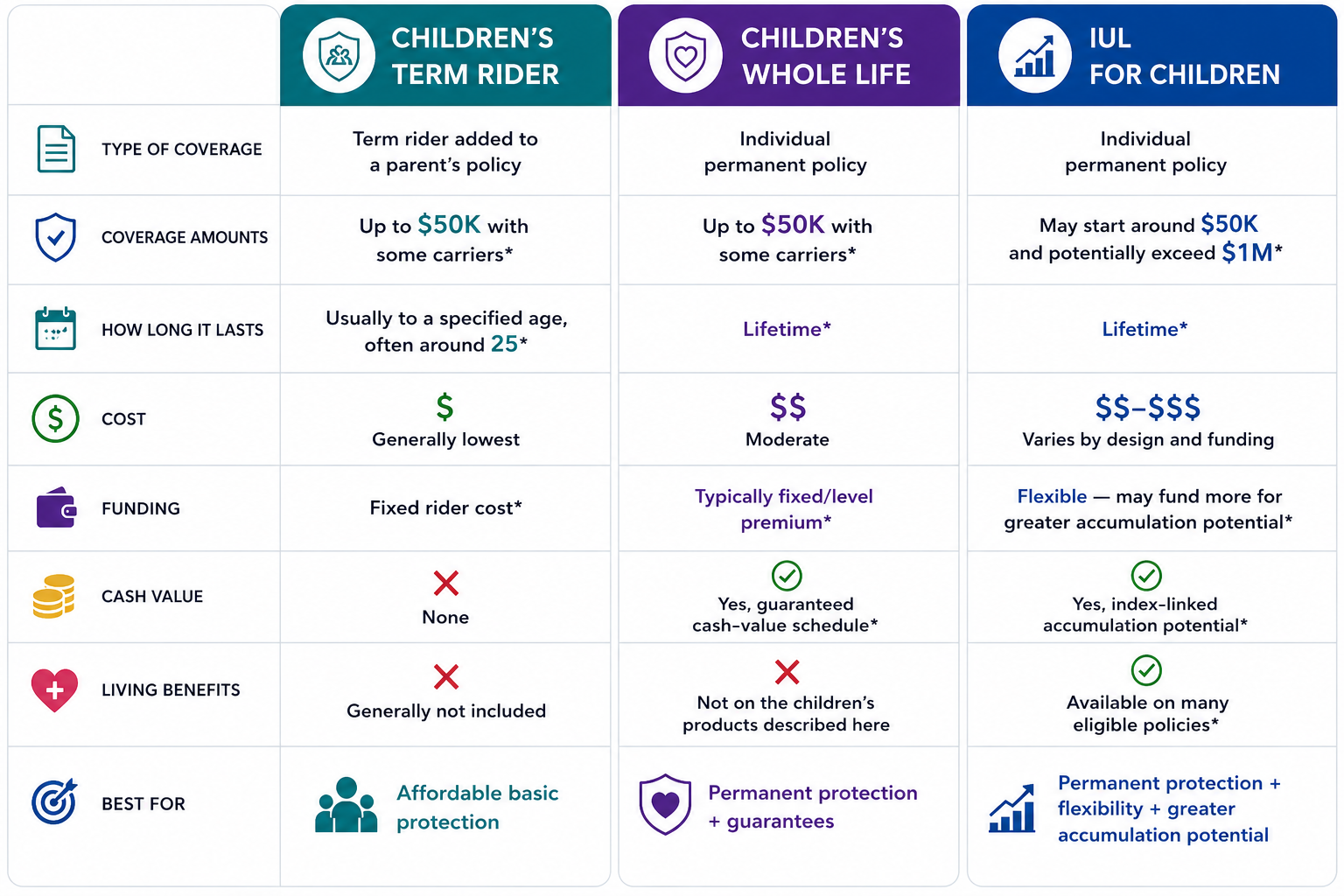
Compare Children’s Life Insurance Options
Want affordable protection? → Term Rider
Want permanent protection with guarantees? → Whole Life
Want permanent protection with flexibility and more cash-value accumulation potential? → IUL
TALK TO A LICENSED AGENT TO EXPLORE YOUR CHILD'S OPTIONS
Coverage amounts, costs, ages, duration, premiums, cash values, Living Benefits, and availability vary by carrier, product, rider, state, underwriting, and policy terms. IUL non-guaranteed values depend on funding, policy charges, credited interest, and policy performance.